
uploaded: 2/1/2026
Originally I was just going to try regularly uploading “thoughts” writings about various stuff, but this turned out to be a lengthier and more difficult endeavor to upkeep than I was anticipating. In order to have some sort of consistent writing structure that would be easier to continually do, I thought a monthly update thing would work well. It’s similar to the logs I did on my RYM account, but should be a lot better I hope. I have a lot of thoughts on that logging business, might type up something about it. My plan for these is to do general categories and then have specifics for stuff that was pretty present throughout the month. Not super in depth or thoroughly edited either, more for casual discussion. Hope you enjoy reading these!
A month or so back I saw the Citizen box set at a local store I frequent. Despite only hearing Aja and Can’t buy a Thrill, I thought it would be pretty cool to grab the box set. The day I got it, a snowstorm rendered me stuck at my parents. I had nothing else to do so I just put the whole thing on. Despite boxsets like this not being ideal for dedicated listening sessions, it was a blast. Their main era is really well defined, and goes shockingly well all together while not being that samey. It really unlocked something in me, cause they’ve become an obsession for me. I’m usually not much into rock music, especially from before the 80s but Steely Dan is pretty special with how it approaches pop/soft rock. It’s mostly just that they have really, really strong pop songwriting sensibilities. It’s what takes them beyond the initial impression of AOR/Soft Rock schmalz. The lyrics are also really great, much has been written about them already but their bitter character portraits are quite compelling.
At the moment I find myself drawn to Countdown To Ecstasy the most. We’ll see how I feel about the albums in between this and Aja on their own at some point, but Ecstasy is their best for me at the moment. A huge jump from Can’t Buy a Thrill, which was good but unfocused. A friend put it best that “they flipped the script… and made their most angular/heavy record”. What gets me is that it’s probably their most “rock album”. I’m pretty against classic/canon rock so it’s quite a pleasant surprise. The solos here are fuckin dirty and intense compared to their other work, and it gets me excited every time. Songs are pretty long across the boat and pretty dynamic. Just great stuff, might be a new favorite of mine. Gonna have to grab an individual CD copy for the car.
Played a lot of it this month mostly cause of an article that may or may not be out by the time this is uploaded. TLDR is that it’s got a solid base with some problems, that charts and community content exacerbate by priotizing gimmicks over fundementals. Fun but bothers the shit out of me.
The first time I tried Nonograms (or as I thought it was called at the time, Picross. Turns out that’s a Nintendo trademark :/ ) was with 3D Picross a couple . I had seen Mario’s Picross before when I was younger and scoured endlessly for new games to play on my GBC. At the time I thought it looked too complicated, and over the years I was generally adverse to puzzle games. 3D Picross felt a lot easier to get into than the traditional 2D format of Nonograms. The novelty of it was appealing but I didn’t put too much time into it. Over the past 2 years I’ve found myself appreciating puzzle games (digital and pen and paper) way more, so seeing this in my steam feed due to how much I play Project Diva made me consider getting it. A friend ended up giving it to me for my birthday and I was hooked. Simple to pick up(insert link to rules) but ramps up in complexity quickly. I probably couldn’t explain the appeal well given I’ve only recently engaged with puzzles, but it’s real satisfying to learn. I really appreciate how jumps in board size are pretty meaningful but there’s still some baseline techniques and tricks that you can apply. The eking out of correct tiles and deduction is quite a great feeling, I should probably start playing more of these logic puzzle games, like Minesweeper.
What I can comment on is the differences between various digital formats and how they try to adapt the pen and paper original. Before Jan 12, Logic S+ had 2 “difficulty” levels, known as Assist Mode. Assist Mode would essentially tell you if a hint number was completed, which is a pretty significant piece of information. When turned off the game will auto complete rows/columns when you’ve filled in all the valid tiles, show errors and allow you to use hints. This is compounded by the star system, which challenges you to not make more than 3 errors, and avoid the hint system entirely. In practice for anyone taking the puzzles seriously, it means the only real advantage in a session is 3 errors and the auto complete. Compared to other digital conversations/platforms for Nonograms I’ve played, this moves it far more into gamey territory, since additional performance-based goals outside of completing the puzzle. Picross 3D utilized some of these, such as the max allowed errors but also added a time limit. I remember being initially annoyed that you couldn’t turn off everything but I found the error cap to be good at facilitating a level of challenge. It was pretty helpful in forcing me to properly learn how to play, while giving some leeway to help with initial guesswork.
More traditional conversions such as Konami’s Pixel Puzzle Connection or Nonograms.org (this site has a comments section which I find hilarious), don’t have any penalty for misplaced tiles. Instead, they more faithfully replicate (Pixel Puzzle adds the hint number completion, but it can lie to you) the pen and paper format, with more immediate feedback on if you correctly solved it or not. Looking at the reviews and Steam forums for Logic+, most people wanted an equivalent to these other platforms, removing all the gamey features from the puzzles. This was later added in an update, allowing you to turn off all assist features. Initially I was confused as to how the star system would apply, but it turns out doing assist off just gives you all of it. Looking further at discussions around it, there were a few people who wanted the feature because it lowered the stress of dealing with errors. I ended up turning back on to the middle ground, cause I found myself not as involved and intense as I used to be. Having burned all my mistakes and being really patient and nervous about every move made the clear feel like such a fucking relief. I’d pretty often send images of this chibi Miku Nonogram game with captions about how I was about to jump off a bridge or similar hyperbolic statements.
On the surface the middle ground assist features seem to make the game easier compared to its initial form. To be honest, I’m not really sure about that. Auto filling completed rows/columns is mostly just taking out busy work for you, like you already have to count constantly to play the game. The main difficulty I see (I haven’t gotten a book yet so I could be totally wrong, soon though!) with pen and paper is the tedium. Making a mistake and rolling with it for long will require a whole ton of erasing and more precise attention. This isn’t really an issue with digital versions since it’s way less effort to reset or fix up a flawed board. The only thing remaining for challenge is time, which isn’t really something anyone should be concerned about until you are really high level. The biggest piece of advice regarding any form of puzzle is that taking breaks is OP! The other issue that comes up with errors is the amount of information they give. It can be pretty helpful to figure out a good starting basis and can basically solve columns/rows for you, even with the limit. There’s also the argument that you can just brute force the puzzle with resets, since it can let you memorize the board. Unless you have photographic memory this stops being an issue after 15x15 boards. I have pretty good memory and I find that attempting to rely on it ends up causing more mistakes than not. Once you get to 20x20 (a look at Nonograms.org will show you it gets fucking crazy) there’s too many spaces to keep track of, especially with the more devious configurations. Lastly, I might be totally off base since I’m still new, but I think you do kinda need some amount of guess work to start some of the more difficult puzzles. The errors help with this in a way that doesn’t degrade the difficulty for me, so I’m pretty happy with Logic S+ as my main method for the moment. Here’s to getting some books and moving onto Nonograms.org! There’s a lot of content but it tops out at 20x20 :(
Rolling Thunder is a game series I’ve been fond of for years, since my NES I got in middle school came with the Tengen port. I was never really dedicated, didn’t clear 1 or 2 which were the ones I owned, and I’ve sampled the arcade original in MAME and at a local cabinet. I’ve been aware of Rolling Bird for some time (maybe even played it based on some Steam play data I briefly spotted before I clicked play) but after seeing some people I read talk about it online, I decided to finally purchase and play it. Given my backlogging tendencies I don’t really mind that I took this long but man what an exciting game, should have been playing way earlier. Granted I probably wouldn’t have had the drive to clear 1 loop back when I found it.
What I like most about this game is its commitment to extremes. Enemies fill the screen and chase you actively. The timer has some leeway but always feels like a threat. While damage is more forgiving than the originals (shots and melee/grenades essentially have different health bars), the sheer volume of encounters and enemies make it common to have one hit convert to death. I haven’t really made a dent in it, but the second loop ups the ante instantly. The biggest example being all of the gun enemies firing two shots, contesting your space and actions even more than before. This combined with the random level generation makes the game really tense and dense. You’re constantly dealing with enemies or gaining distance, lots of decision making at any given moment. What hooked me on Rolling Thunder was this fight with a guy poking out of a barrel in the first level. That fight felt so cinematic to me when I first played it, straight out of an action movie scenario. Rolling Bird is chock full of those moments and it’s such a delightful rush to get overwhelmed and claw through.

The proc gen ends up being the least interesting part of this game for me, if I’m being honest. It’s meaningful though and learning to guess and take advantage of the level is a pretty big skill. To me, it just ends up as a subtle contributor to how each run plays. If the enemies and general game speed were closer to the original Rolling Thunder, most of it wouldn’t matter. The speeding up and increased lethality give the proc gen levels the ability to actively affect fights instead of just being backdrop you can ignore with enough familiarity/legacy skill (which is the issue with every action roguelite in my experience. There’s a reason most new ones are taking a turn-based approach!) Excellent game, hopefully I can get a 2-ALL soon!
I’ve messed around with Mr. Driller several times in my life, but not until now did I finally have it grip me. This time it was a result of getting Drill Land as a birthday gift. I initially thought I was going to be getting a nice arcade port with some neat minigame bonuses but it turns out, Drill Land is tried and true console game. This shit has got progression and all the stuff that consoles added on to arcade games to pad length and add extra content. It’s a little annoying but I ended up not minding. Drill Land is split into attractions, which aside from the Drill World Tour are variants of the standard Mr. Driller experience. Space adds pick-ups with positive and negative effects. The other 3 remix the game into slower, adventure type games. They all mostly get rid of the timer, which isn’t really a benefit outside of making it easier. 2 of them act as elaborations on the various higher skill clears of the base game. Drindy’s adventure focuses on no-missing, removing puzzle elements and doubling down on threats. Ghost house makes air capsule chaining the game, by making the items active enemies that you need to position properly. While there’s some scoring rules in each of those, most of the advanced play has been moved to time, which is fine since it was already a part of the game to begin with.
There’s one attraction of note and it’s kind of a piece of shit, but I love it. It’s modeled after The Tower of Druaga, a Namco classic I have yet to sink my teeth into. It tries to convert the formula into more of an adventure/resource management game. Unlike the other remixed attractions, the timer is actually here in the form of an HP bar that drains with each action or damage taken. All this really does is make you play slower since there’s benefit to making the right decision each time. In the other attractions you can at least play fast and slow down when there’s something to interact with. The main gimmick is the map/progression and the Dristones. Instead of linear progression it’s got branching paths like a dungeon, and reaching the bottom will give you a warp to go somewhere else if there’s nothing to continue. You gotta make guesses to look for the key and then the exit. Dristones are pickups that do various things like recolor, destroy or affect block interaction. In effect you pick up a ton of these and then menu scroll to the healing or damage/recolor for the boss. The boss is so fucking boring, it’s an endurance test/resource check where if you don’t come in pre-stocked, you gotta go on for ages till you get a damage or recolor pick up. The exploration is really annoying and tedious too, feels mostly like guessing. Despite how much of a slog it is, I kinda love it? Druaga is notably a frustrating weird game, so I’d want a homage to have some of that eccentricity. While this isn’t as compelling as I expect the original to be, I dig the attempt at converting even it’s annoying shit (items) to an action puzzler.
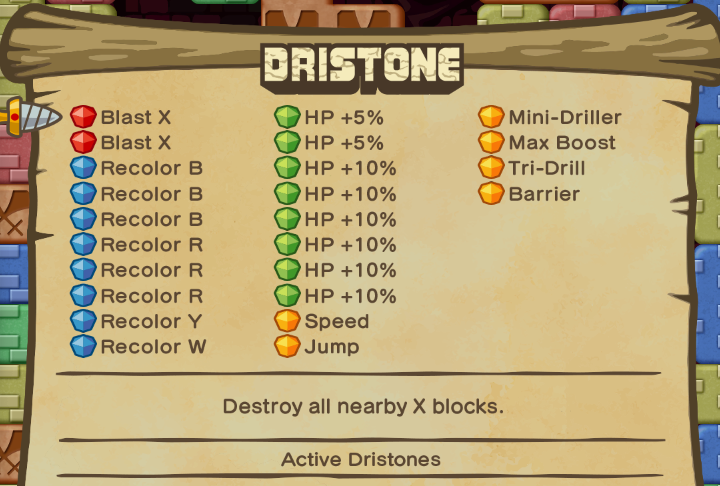
Shockingly Drill Land doesn’t really nerf the difficulty to my knowledge. All it does is enforce the progression of difficulties that already existed in the Mr. Driller 2 and G as I later found out. Since those easy modes take no time, it's not that bad. Regardless, it gave me an itch to check out the arcade game proper, and thank god it did. I really underestimated these games! Every time I recall playing it I just dug straight down until I hit an X block, needed an air or was about to get hit. Just complete auto-pilot. Playing it for real now I can see just how well made and enjoyable these games are.
I believe I got a clear of the easy mode on the original arcade game some time before, but never recorded it. I recall brute-forcing the clear and learning nothing about how to play the game, so this became my first real time with the game. The first thing that piqued my interest was realizing air capsules increase their score value per gain. I never looked into Mr. Driller scoring before so figuring out a basis for the system had me interested. I started going for all air capsules as a result of my habit for focusing on scoring systems before beating the game. I’m glad I did this though, cause it made me notice how engaging the game was beyond the surface. Since I was moving from side to side for the air capsules, dealing with the blocks became a more active part of the game from the get-go. Not to say the game doesn’t force this later on, but when you don’t give a shit it’s easy to think you just got to dig down fast. Figuring out how your actions will play out is quite exciting, and given the limited screen space it’s easy to forget the situation is up top and have things go to shit. It mixes reactive and proactive decision making quite well and effortlessly; You start to barely notice how many decisions you’re actually making! The X blocks are so good man. Initially they seem like minor obstructions, but once the later floors hit you get forced to respect them hard. Since they block off the capsules you got to start learning how to either set up a clear column to get access, or how to carry other X blocks down with you. This bit of multi-tasking only escalates the chain reactions from blocks falling, making it get even more exciting.
You’ll start finding yourself in this very engaging loop of navigation, then spending a bit waiting for the consequences or set up, and then back to movement. It works cause that time mostly acts as a buffer for you to plan out your next actions, so it never feels like time is wasted. The way you constantly shift between active and passive play while still being on a timer reminds me greatly of TGM. Unlike TGM though, where the rapid think and act cycle is largely enforced, Mr. Driller gives more agency to these phases. Given the game’s more character centric approach that revolves around inherent consequences to decisions, I think this choice fits quite well.
It’s been one of the more rewarding games I’ve learned lately, especially as someone tries to limit their viewing of high-level play for games until wanting to really optimize. The basic beginner clear felt good to finish on a base level. Realizing that you do have more time than you think to figure out how to deal with the X Block set ups in later stages is pretty important. Still, it’s not free as I’ve learned through later playing. I’ve had a couple runs die cause I waffled around to long. You gotta keep the pace up! After a clear you’re given 3 other notable statistics that you can choose to focus on. You can go for “perfect air” (not missing a single air canister), no misses and time. These all intersect with each other of course, but being able to gradually build to doing all of them is very refreshing to see compared to what I usually play. For my money the best one to go for is air capsule chaining. I got it while messing around in Mr. Driller G and it felt so good. It makes you engage with the whole game much faster as I’ve mentioned earlier. I haven’t seen much high-level play due to my preference of learning as much as I can on my own. The one clear I watched started off with the player auto firing X blocks to get the air capsules. In the description, the player admits the start is a bore and so I clicked off the video satisfied with what I learned. I was already realizing it with my better runs, but the loss of air isn’t that big of a penalty, and the optimization shown here wasn’t relevant to my play.
There are just so many little tricks and things going on. Despite being pretty close to understanding most of the basic details, I still keep finding little tricks that just make me adore this game. That you can delay blocks falling by drilling the block above you, in order to give yourself more time to think or plan, or just to buffer a shift between columns. It’s just shockingly dense and smart, I wanted to keep adding little things I noticed but I’m better off reviewing it later I guess. I really shouldn’t be surprised, it’s Namco, these guys are undisputable champs of arcade games. But man, this shit is so fun. I’ll be happy to clear as much of the series as I can.
Not much I think needs to be elaborated on. Some pretty important relistens though. I had a minor grime kick at the start of the year, due to this upload of Ice Rink that stitches together a bunch of assorted vocal performances on the track. Wiley’s early instrumental work is really crazy stuff. Ice Rink in particular is astounding to me. It might be one of the funniest things I’ve ever heard, but it goes so hard. Super simple and extremely goofy sound palette (the fucking water noises man), but there’s such a skilled display of space and arrangement for dance music. It just gets better with people going over it. I intended to hear more grime but what ended up happening was fixating on Dizzee Rascal’s debut, Boy in da Corner. While I still think it’s got some rough spots I can’t overlook, it’s still such a strong album. What hits me the most this time is the misanthropy, namely in the track Sittin’ Here. It’s a very nervous, contemplative track that gives great backdrop to Dizzee’s teenage malaise. The thing that makes it work throughout the album is that he’s actually 18. The things he’s saying aren’t particularly deep, and are pretty teenager when you get down to it, but the delivery and sharpness for his age make it engaging. Lot of “what is this kid’s problem?” going on here.
It’s been ages since I’ve heard any Duster. One of the quintessential high school artists for me. I was totally obsessed with them, I was listening to all of the bootlegs (but not Valium Aggneum or the solo works from the band members, still haven’t heard those lol.) and whatever I could get my hands on. Since then, I think I’ve only heard Contemporary Movement like once in the past year cause I was showing it to a friend. I’ve been revisiting a lot of old favs as a project for a bit now, and with the snow finally coming down, Duster was back in season. Both of the pre-revival albums were favorites for me at the time, with my preference eventually going towards Contemporary Movement, despite seeing them as basically equal. Nowadays, Stratosphere ended up waning for me. While it’s still an excellent album, melodies and atmosphere are on point, there are some cracks in it that are more apparent to me now. It’s a bit all over the place, way too long and a bit thematically jarring at times. Certain transitions are pretty weird now, back when I loved every song deeply this wasn’t an issue but now it just catches me constantly. Even back then its reputation as a sad album kind of escaped me. Certainly, it’s melancholy and dour but the space theming and instrumentation lent it a sense of wonder that was present throughout. These things can coexist and synergize, it did back in the day but it’s not quite there at melding these 2 modes for me currently. Contemporary Movement did not budge at all thankfully, in fact it’s so much better I’m not sure how that’s the minority opinion. I plan to discuss it more thoroughly over on the other site, but god it’s so good. It plays with the form of indie rock/slowcore so well, the songs aberrate from what they feel like they should be frequently. It just hasn’t lost any luster for me, and the move from lo-fi worked in their favor cause the guitar tones are still so evocative.
Weird month for movies, a lot of watches but not the usual kind for me. Many of them were pretty famous blockbusters, such as T2. I tend to avoid seeing these cause there’s way more interesting stuff for me to check out first. I also don’t really watch movies frequently, so I’d rather watch some cool shit over the famous stuff. Watching T2 was informative for me, just to see a defining classic and piece together its influence. Great film, I can see why people in the 90s would watch a film in theaters over and over again. The effects are fuckin crazy! Lot of stupid trash too since my friend I usually watch movies with wasn’t in the mood for good movies. The Neighbors duology is really something. They honestly could make a third one now and have it centered around queer college kids, this is a billion-dollar idea. Red rooms was another weird one, effective at shocking you but not sure it does anything particularly meaningful. 100 Meters was shockingly amateur. For some reason it decides to use rotoscoping exclusively after the first third, and it’s not good. Impressive sure, but it looks fuckin dumb most of the time. There’s one great sequence in the middle using it but otherwise why did they do that shit. It’s also kind of a boring story in general for me, but whatever.
The two notable films (well genre/format in one instance) were silent comedies and If I Had Legs I’d Kick You. I mainly watched the Buster Keaton silent comedies, because of that one image pictured below. Me and a friend had been planning to do this for months and we finally got around to it. For starters, cognac is fucking excellent. Amazing drink, so nice and the burn is refined. But onto the actual thing, these films are great. I watched One Week, The Cook, The Scarecrow, and Sherlock Jr. I saw the middle 2 a couple months back and thought they were fun but it didn’t leave an impression on me. Watching them all drunk really unlocked the appeal of silent comedies for me. Just great physical performances, and a real ingenuity towards set design and stunts that while I believe common at the time, is pretty impressive to see today. Big fan of the spinning house gag in One Week and the dream sequence in Sherlock Jr. Crazy filmmaking, love to see it. If I Had Legs was a sleeper for me, by the end I found it had hit me way harder than I was expecting. A really good depiction of stress, dependence and figuring shit out. For some reason people seem to liken it to Uncut Gems, maybe the worst comparison in Letterboxd history. Actively pisses me off.
Last year was important for me, as I decided to finally start reading books more often. I had basically only done it for school, never leisure. I ended up reading 10 books by the end of the year, not bad for only starting halfway through! So far it’s been relatively light though. I’ve been slowly making my way through Territory of Light by Yuko Tsushima. I was recommended a different book (short story collection) by her a bit ago when I was telling a friend about my dissatisfaction with No Longer Human. Could only find Territory in my local library, so that’s what it had to be. So far I’m waiting to see if it’ll leave an impact on me. It’s very ambient/slice of life, not much particularly happens. A lot of my favorite stories are like this, but it isn’t doing that much for me. Her prose is good though I can’t identify much (not very experienced with literature), feels light and precise when translated over to English. I wonder if reading it in the way it was initially printed, month by month in a magazine over an entire year, would improve. Regardless of how it turns out, I might get a copy to try reading it like that at some point.
I got a couple books from Primary Information, due to a friend notifying me of a sale. There was one last year that I was going to purchase during but I missed it, so really happy to catch it this time. The book I was aiming for was Thing, a complete collection of all the issues of Thing magazine. I haven’t started yet and most of the info I could tell you about is right on the back/site, so go read that. I’m very excited though, if you know me you know that dance music is pretty important, and this is quite a tome of info. There’s a ton of artists I’m familiar with in the list, and flipping through the book is quite a delight. Lots of really cool formatting, so awesome to see. I was recommended Live Audio Essays by Lawerence Abu Hamdan, which I got along with Thing. I was expecting more of a general theory/critique book but I was pretty surprised. These are transcriptions of performances/films so there’s some stuff lost, but it’s been great reading so far. It’s more of an exploration of the capacity of sound and speaking in areas you wouldn’t expect from the 3 or so chapters I read. Obviously the sound stuff is my shit, and Hamdan writes about it well. The first chapter was the one that stuck out the most, where he talks about the concept of Natq and how his cousin uses it. Not much is on it online from my digging into the English internet, but it’s reincarnation in Arabic (maybe in Lebanon specifically). He proceeds to describe how his cousin is the reincarnation of a child soldier, and how his cousin becomes an oral historian and begins to use his reincarnated status to figure out what happened. It is wild stuff, and really interesting to learn about how this is a custom in Lebanon. The way it interfaces with politics is also quite compelling. I’ll probably finish this by next month, breezy and interesting read.
So, this ended up being the first real year (so far) of this website’s existence. I kept sitting on it for years thinking I’d finally get to writing something or blah blah. Going plain text was really the move, helps me focus on populating the site with something real as opposed to just lingering around and telling myself I’d work on something and then getting brick walled. I’m starting to figure out what I’d actually like to put on here, and I’ve embraced a slower approach that’s doing wonders. Here’s hoping I don’t go dormant again! I doubt it though, been a while since I’ve just had nights of just working on the site, feels good.
I visited the Cliff Walk in Rhode Island this month for the third time. It’s become a ritual between me and my best friend at this point. Usually, we went later in the day, since our initial reason for visiting was to see it during blue hour. If you haven’t visited a coast area during blue hour, I’d highly recommend it. Pictures online don’t really do it justice, mostly cause it’s AI generated or edited garbage but also it’s just really hard to capture in photo. The hue of blue that appears is very subtle, it lives up to the name but I couldn’t describe it. This time we went there in the middle of the day so we got to go further along the walk. It’s quite long and not very well lit; Every other time we went, bringing a flashlight slipped our mind. I like the way it gets rockier and closer to the ocean as you go along the trail. It feels pretty cinematic or narrative, bolstered by the sections having very extra names. One interesting thing about this walk/nature spot is the proximity to the wealthy. Usually, the people who own property around these spots are generally farther away, a decent amount of land is public property. Here it’s only the walk, you’re at all times sandwiched between the ocean and lavish estates. Not much otherwise, I would have liked to visit a local Round 1 but time did not allow.
<<< back